

A reel handle is a lever. Changing its length alters the hand force needed to create torque at the drive shaft, the distance your hand travels in one revolution, and how clearly changes in lure resistance are felt. It does not change the reel's gear ratio or the amount of line retrieved per handle turn.

The mechanics: torque and radius
For a force applied perpendicular to the handle arm, torque is:
Torque = hand force × handle radius
If the handle radius increases while required reel-side torque stays the same, the necessary hand force falls in inverse proportion. Moving from 60 mm (2.36 in) to 52 mm (2.05 in), for example, requires approximately 15% more hand force to create the same torque: 60 ÷ 52 ≈ 1.15.
The reverse is also important. If the angler applies the same hand force after fitting a longer handle, more torque reaches the reel. That extra leverage can be useful under load, but it also makes it easier to apply forces beyond those experienced with the original handle.
What a longer handle changes
Less hand force under load
A longer lever reduces the force needed to turn the drive shaft against lure resistance, current, drag pressure, or a fish. This can reduce perceived effort when retrieving high-resistance lures or working a reel under sustained load. It does not add motor-like power; it changes mechanical advantage.
A larger hand path
Your hand travels one circumference for each crank. At 60 mm (2.36 in), the path is approximately 377 mm (14.8 in) per revolution. At 65 mm (2.56 in), it grows to approximately 408 mm (16.1 in). The larger motion can encourage a steady cadence, but it may feel less compact when starting, stopping, or making very small corrections.
Load changes may feel muted
Mechanical advantage reduces the hand-force change produced by a given change in lure resistance. That can make a high-resistance lure easier to retrieve, while also making small variations in current, bottom contact, or blade vibration less pronounced at the hand. “Sensitivity” remains influenced by the rod, line, reel rigidity, knob material, lubrication, and the angler's grip, so handle length is only one contributor.

What a shorter handle changes
More hand force for the same output torque
A shorter radius provides less leverage, so resistance at the reel feels heavier. That can help reveal small changes in load, but it also increases effort with deep-diving plugs, large blades, heavy current, and hard fighting fish. Fatigue can erase any control benefit if the handle is shortened too far for the application.
A smaller and potentially quicker motion
The hand covers less distance per revolution. This can make stop-and-go retrieves and small cadence changes feel compact. At a fixed tangential hand speed, a shorter circle also permits more revolutions per minute. Actual line pickup still depends on how fast the angler turns the handle and the reel's unchanged retrieve per crank.
The original 60-to-52 mm example
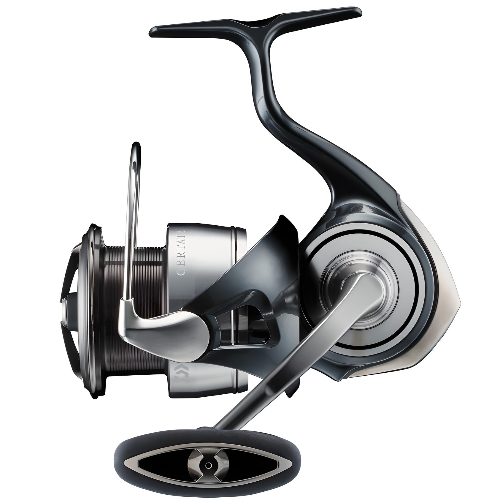
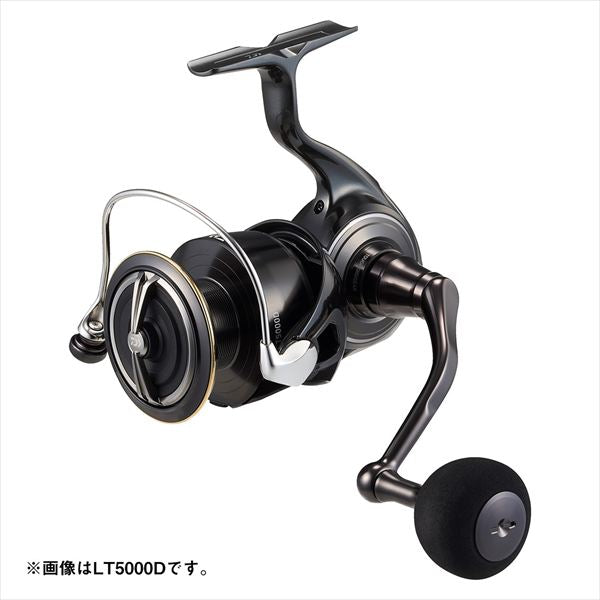
The source article describes replacing a 60 mm (2.36 in) handle on a Certate LT4000-C with a 52 mm (2.05 in) handle for surf fishing. Mechanically, that change reduces hand travel by about 13% and increases the hand force required for the same torque by about 15%. The author reported clearer load changes but more fatigue with high-resistance lures. Those observations are consistent with the leverage change, but the preferred balance remains personal and application-specific.
Shop the Gear

Metric handle-length comparison
The table uses a 60 mm handle as the reference. “Relative hand force” is the force required to create the same reel-side torque; it does not represent a reel durability rating.
| Handle radius | Hand path / turn | Relative hand force | General effect |
|---|---|---|---|
| 50 mm | 314 mm | 120% | Compact motion; substantially more force required |
| 52 mm | 327 mm | 115% | Shorter travel; resistance changes feel more pronounced |
| 55 mm | 346 mm | 109% | Moderately compact compromise |
| 60 mm | 377 mm | 100% | Reference configuration |
| 65 mm | 408 mm | 92% | More leverage; larger hand path |
Specifications in Pounds, Yards & Inches
| Handle radius | Hand path / turn | Relative hand force | General effect |
|---|---|---|---|
| 1.97 in | 12.4 in | 120% | Compact motion; substantially more force required |
| 2.05 in | 12.9 in | 115% | Shorter travel; resistance changes feel more pronounced |
| 2.17 in | 13.6 in | 109% | Moderately compact compromise |
| 2.36 in | 14.8 in | 100% | Reference configuration |
| 2.56 in | 16.1 in | 92% | More leverage; larger hand path |
The handle does not work alone
- Knob size and shape: a larger knob can reduce grip effort and change wrist position, sometimes affecting comfort more than a small length change.
- Handle mass and balance: extra mass changes rotational feel and can cause the handle to turn under its own weight when the reel is held at an angle.
- Gear ratio and spool diameter: these determine line pickup per crank. Handle length changes leverage, not the published retrieve distance.
- Rod and lure resistance: a long handle that suits a high-drag plug may feel excessive with a low-resistance finesse presentation.
- Single versus double handles: manufacturers may quote dimensions differently. Confirm whether a figure is shaft-to-knob radius or total center-to-center length.
Compatibility and safety checklist
- Confirm the exact reel and model year. A handle that fits one generation or size may not fit another.
- Verify shaft type, thread direction, and handedness. Do not force a part that does not thread smoothly by hand.
- Check knob and bail clearance. The knob must not strike the body, bail, rotor, or reel stand through a complete revolution.
- Use the required washers, bearings, collars, and retaining hardware. Incorrect stack height can create play, binding, or incomplete engagement.
- Follow the specified tightening method. Excessive torque on small fasteners can damage threads or bearings.
- Do not assume a universal length limit. The source suggests staying within 10 mm (0.39 in) of the original length, but that is not a model-independent manufacturer standard. Use only combinations approved by the reel or parts maker.
- Keep every original part. Restore the factory configuration before manufacturer inspection or service when required by its service policy.
A low-risk way to experiment
Begin with the factory handle and record how the reel feels with the lure types you actually use. If high resistance causes fatigue, test a modestly longer compatible handle. If small changes in load are difficult to distinguish and the lures pull lightly, test a modestly shorter one. Change only one variable at a time, retain the same line and lure, and stop if the reel develops binding, abnormal noise, excess play, or contact between parts.
Bottom line
Long handles trade a larger hand path for increased leverage. Short handles trade increased hand force for a smaller motion and more apparent changes in resistance. Neither is universally more powerful or more sensitive, and neither changes the reel's gearing. The best length is the compatible configuration that balances lure resistance, cadence, fatigue, and control for the intended fishing.