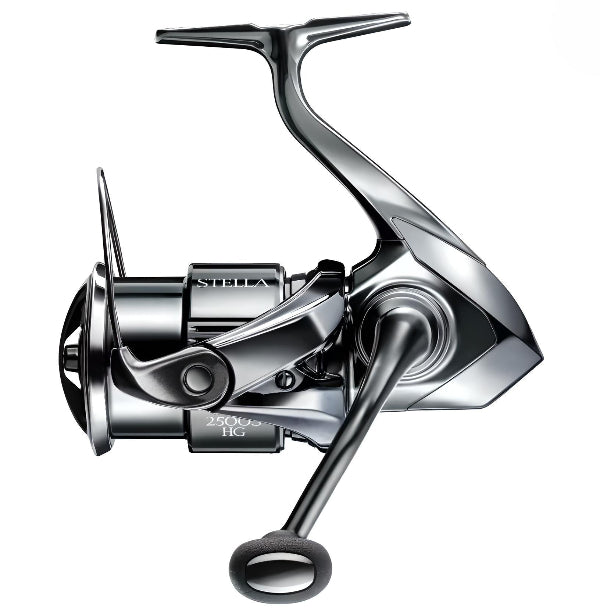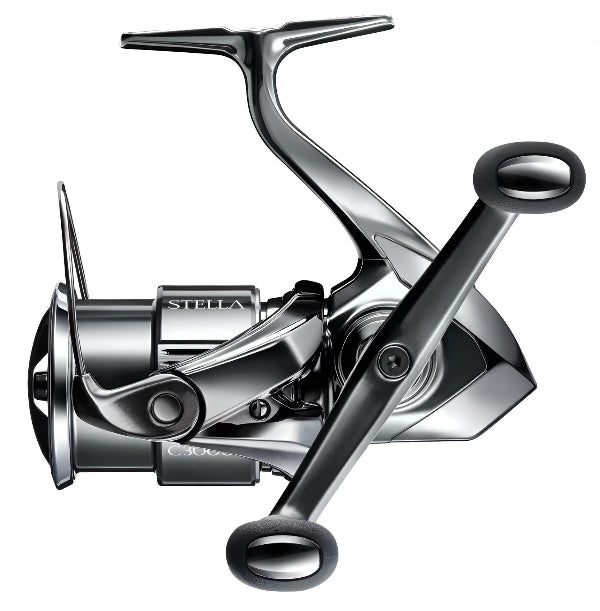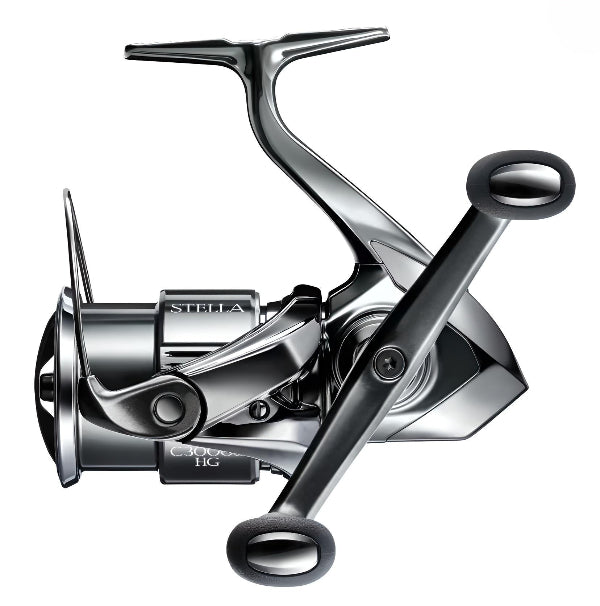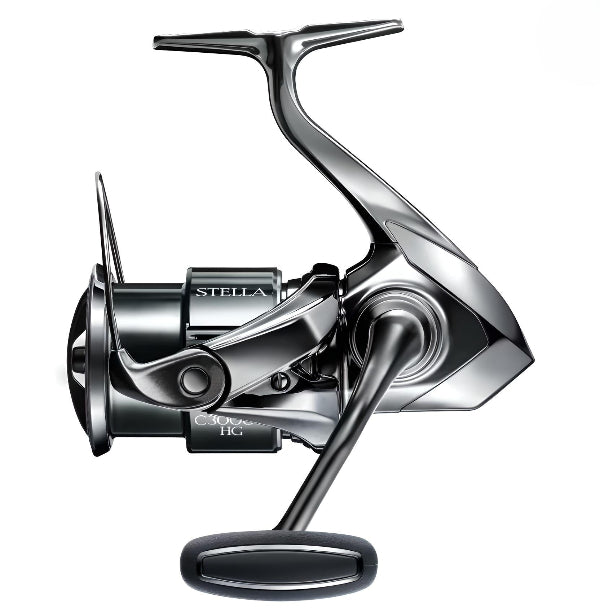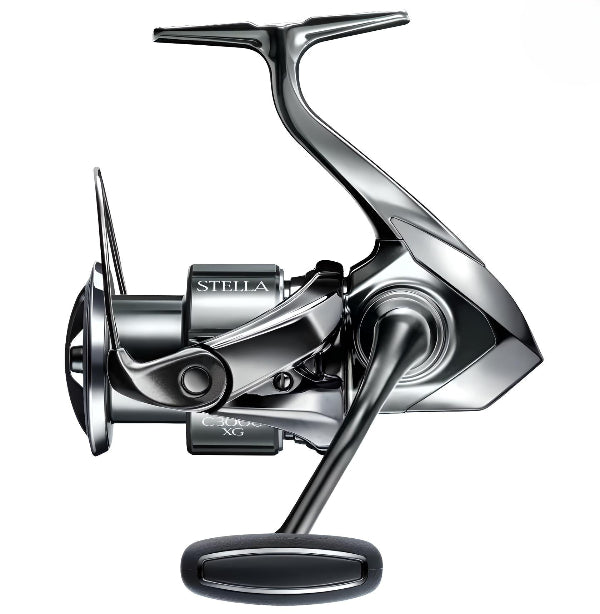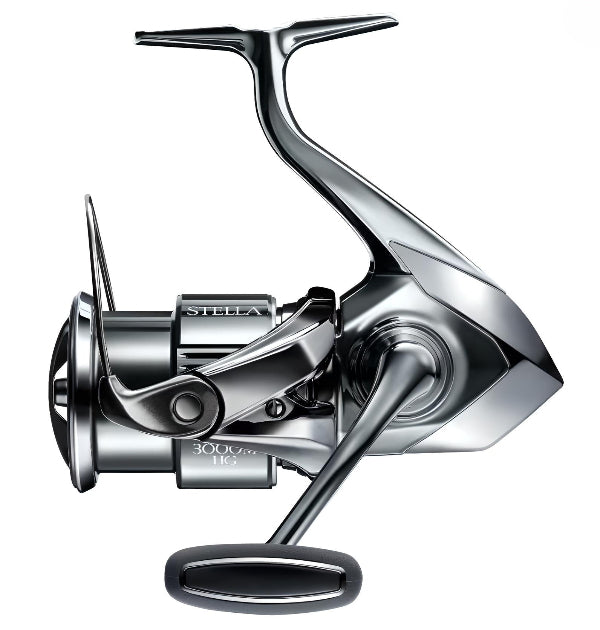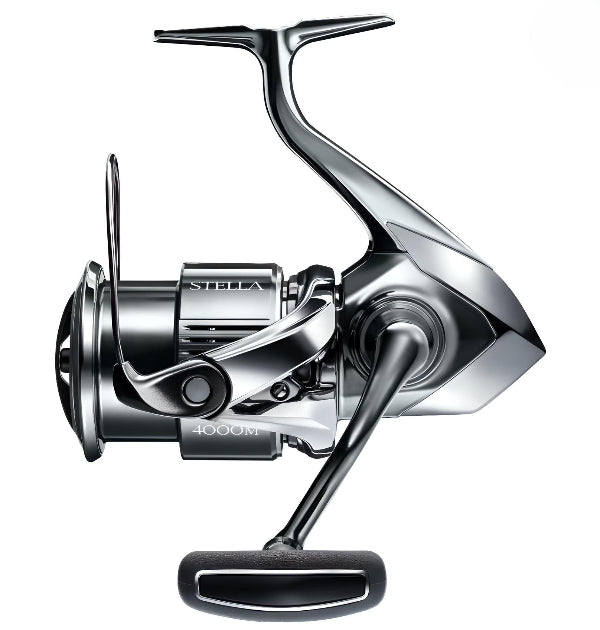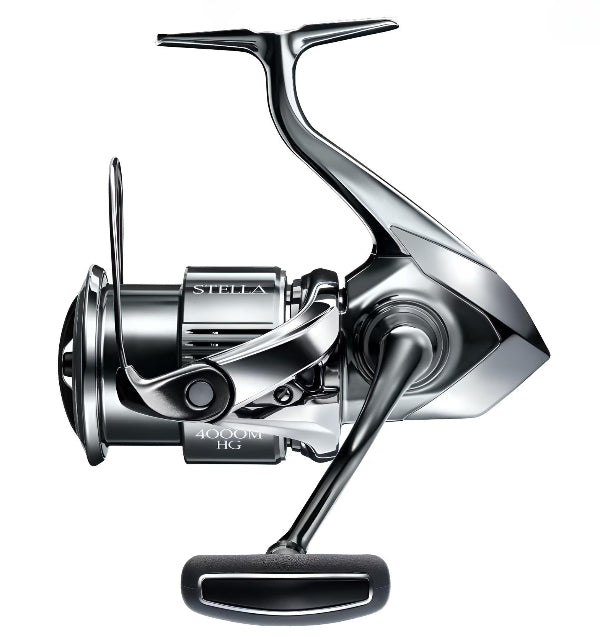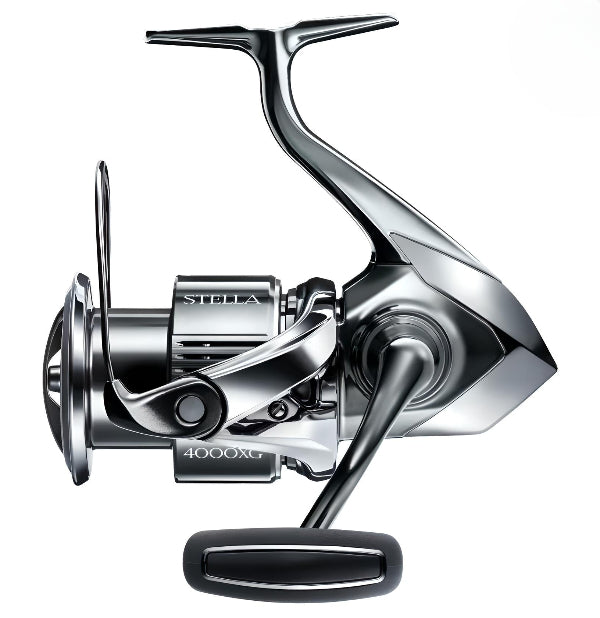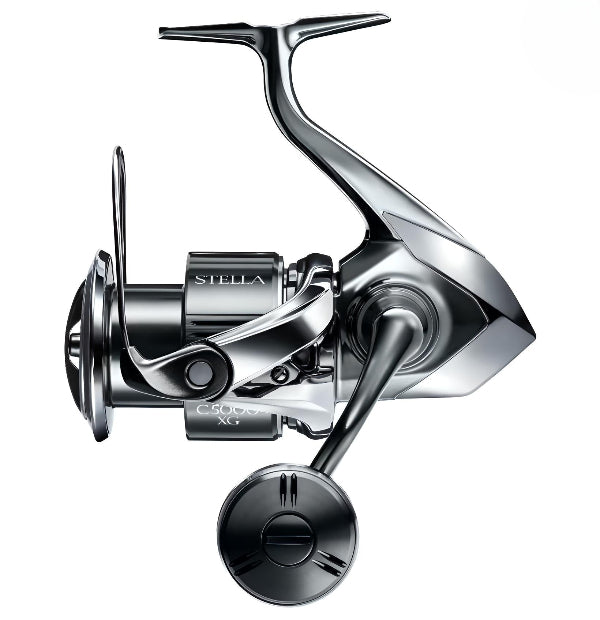
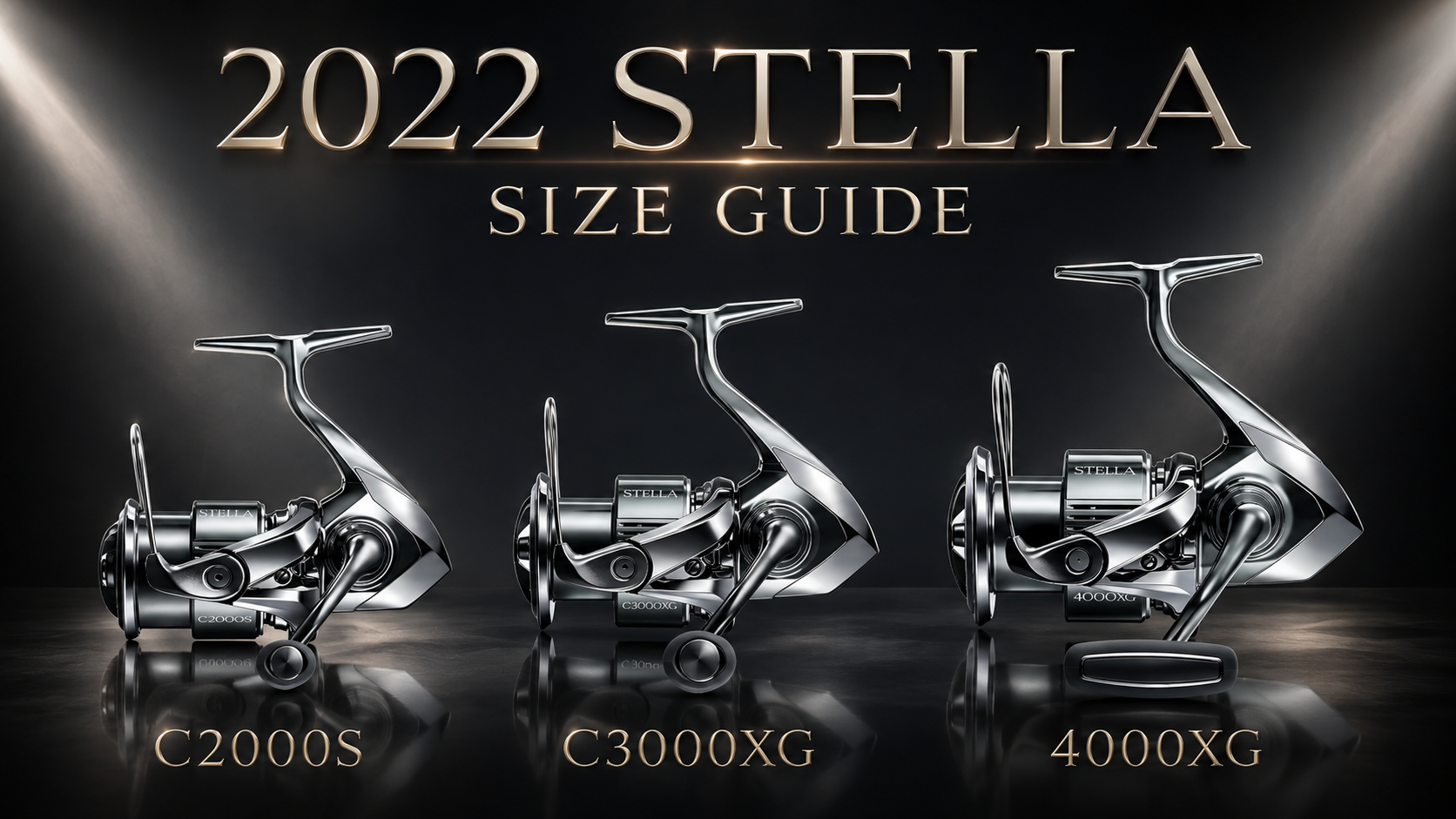
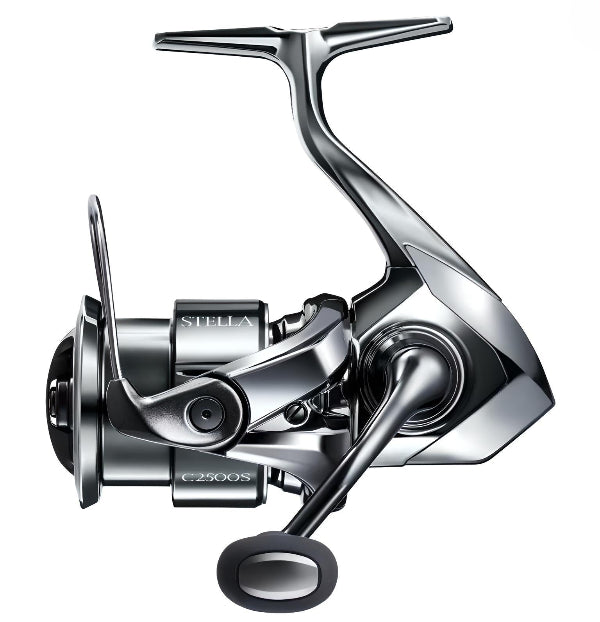
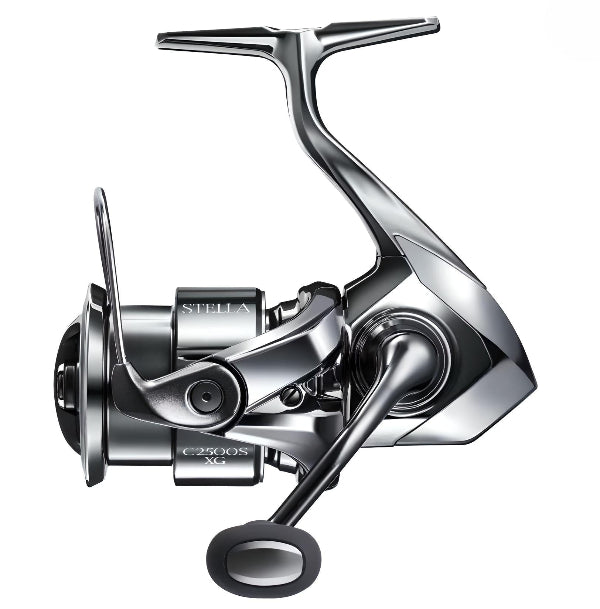
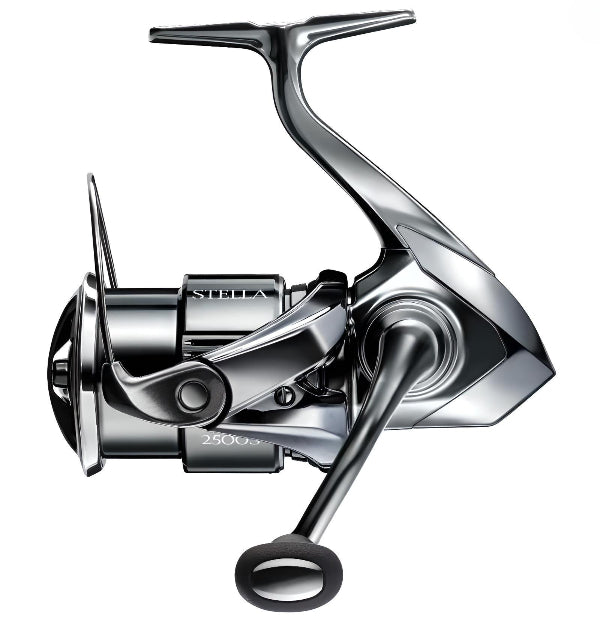
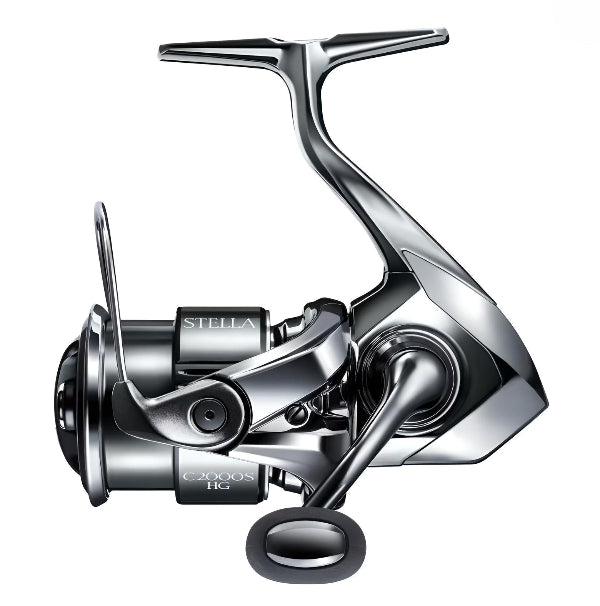
The 2022 Shimano Stella is the general-purpose flagship spinning-reel family, distinct from the larger Stella SW range. Its design combines a rigid CoreSolid architecture with a metal body, long-stroke spool, very slow oscillation, and a series of drivetrain, drag, and line-management systems.
This independent English reconstruction removes promotional rankings, retailer links, unsupported superlatives, and personal recommendations. Technology claims are qualified against Shimano's own descriptions and test conditions, while all 16 general-purpose models are converted into international measurement and line-strength formats.
The mechanical foundation
CoreSolid rotor behavior
Shimano classifies Stella within its CoreSolid family. A relatively rigid rotor with deliberate rotational inertia resists abrupt changes in speed once moving. That supports steady-cadence retrieves, but it is not the same as having a lighter, low-inertia rotor that starts and stops with minimal input. Neither behavior is universally superior; the preferred response depends on presentation.
Metal body and drivetrain alignment
The HAGANE Body uses metal construction to limit flex and torsion around the drivetrain. Maintaining gear alignment matters most as load rises, because deformation can increase friction and alter tooth contact. Stella also uses a worm-shaft oscillation system and 12 ball bearings plus one roller bearing on single-handle models. The two double-handle versions use 14 plus one. Bearing quantity identifies support locations but does not independently prove smoothness or durability.

Four technologies that define the 2022 redesign
Infinity Cross: distributing gear load
Infinity Cross increases the contact area between the drive and pinion gear teeth so load is spread over a wider surface. Shimano reports approximately twice the gear durability of its previous design in an internal standardized durability test. That figure is a manufacturer test comparison, not a guaranteed service-life multiplier in every fishing environment.
Infinity Loop: very slow oscillation
The spool moves vertically at a much slower rate, creating dense, orderly line lay. Shimano states that this reduces line-release resistance and supports smoother casting. Dense line lay also makes spool preparation important: uneven tension, damaged line, or poor winding can remain concentrated across many adjacent wraps.
Infinity Drive: reducing shaft resistance
Instead of supporting the main shaft directly through the pinion in the earlier arrangement, Infinity Drive uses a low-friction bushing and surface treatment to reduce sliding resistance. Its purpose is to preserve winding efficiency as load increases; it does not remove the need to match drag, line, rod, and gearing to the task.
Anti-Twist Fin: controlling slack near the roller
An elastic fin sits close to the line roller to control loose line. It is designed to reduce line dropping below the spool and to limit twisted slack being wound back onto the spool. It assists line management but cannot correct unsuitable spool fill, damaged line, excessive twist, or poor bail handling.
Drag, casting, and durability systems
- DuraCross drag: a cross-woven fiber structure intended to retain smooth drag behavior while improving wear resistance. Shimano reports more than ten times the wear resistance of its previous washer in an internal comparison test.
- Rigid Support Drag: bearings support the spool and main shaft to reduce spool movement under drag load.
- Long Stroke and AR-C spool: spool length and lip geometry manage the decrease in line diameter during a cast and control line release.
- X Protect: water-repellent treatment and labyrinth geometry reduce water entry at designated locations without a contact seal.
- One-Piece Bail and S A-RB bearings: a joint-free bail wire supports line travel, while shielded corrosion-resistant bearings address salt crystallization and contamination.
Shop the Gear
How to read the model codes
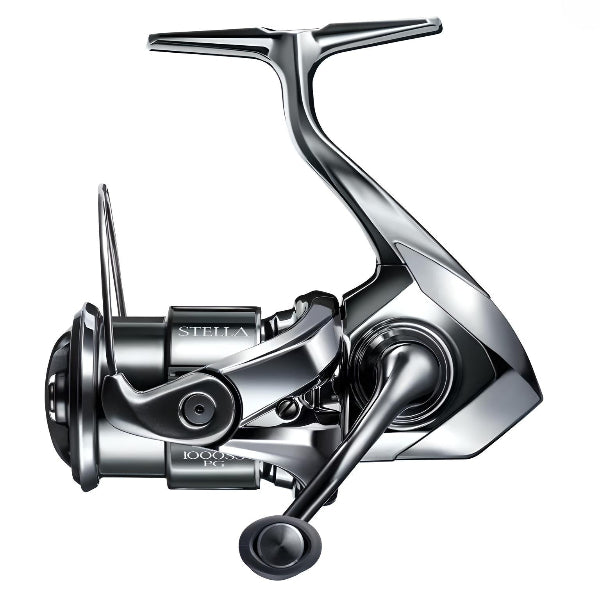
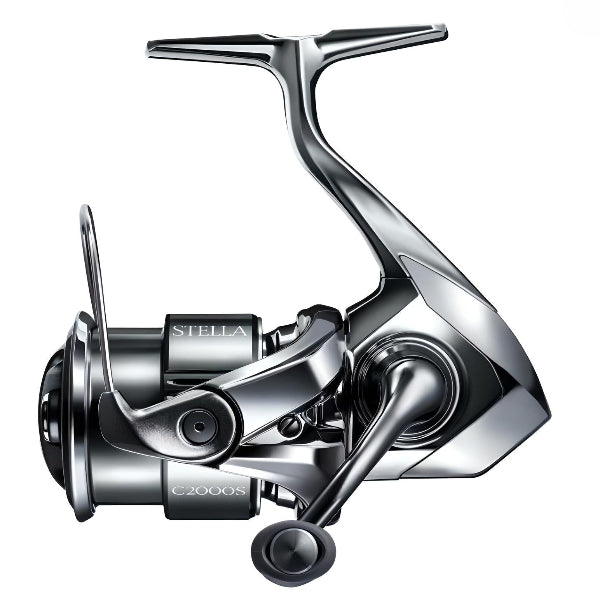
- C: compact-body configuration, pairing a spool class with a smaller body class.
- S / SS: shallow / super-shallow spool for lower line volume.
- M: medium-depth spool.
- PG, HG, and XG: power, high, and extra-high gearing.
- DH: double handle. These models also list 14 ball bearings rather than 12.
Model codes are only a starting point. Compare line capacity, maximum pickup per turn, handle length, spool diameter, and drag range before choosing.

Selecting a size by system requirements
1000 and C2000: minimum line volume
The 1000SSPG has the smallest 40 mm (1.57 in) spool, slowest 55 cm (21.7 in) pickup, and 3 kg (6.6 lb) maximum drag. C2000 models increase spool diameter to 43 mm (1.69 in) while retaining the 1000 body class. Choose between 69 cm (27.2 in) and 81 cm (31.9 in) pickup based on cadence and slack recovery.
C2500 versus full-size 2500
C2500 models use a 44 mm (1.73 in) spool and 1000-class body at 175 g (6.2 oz). The full-size 2500 models move to a 47 mm (1.85 in) spool and 2500 body, weigh 205 g (7.2 oz), and raise maximum drag from 3 kg to 4 kg (6.6 to 8.8 lb). The larger platform is not automatically better; choose it only when its load capacity and balance match the setup.
C3000 and 3000: several distinct configurations
The shallow-spool C3000SDH models combine a 47 mm (1.85 in) spool, compact body, double handle, and 9 kg (19.8 lb) maximum drag. C3000MHG and 3000MHG provide medium capacity, while C3000XG combines deep capacity with 94 cm (37.0 in) pickup. The 3000MHG uses a full-size 3000 body and weighs 235 g (8.3 oz), compared with 210 g (7.4 oz) for the compact C3000 models.
4000 and C5000: highest capacity and load
These models share a 52 mm (2.05 in) spool diameter and 11 kg (24.3 lb) maximum drag. The 4000M and 4000MHG use medium-depth capacity with 87 or 93 cm (34.3 or 36.6 in) pickup. The 4000XG and C5000XG both retrieve 101 cm (39.8 in); the C5000XG has the deepest braid capacity and a round aluminum handle knob.

Choose pickup and handle leverage together
Within the 4000 family, a change from 5.3:1 to 6.2:1 raises pickup from 87 cm to 101 cm (34.3 to 39.8 in) per turn. The XG model also lengthens the handle from 55 mm to 57 mm (2.17 to 2.24 in), adding a small amount of leverage. Higher pickup assists fast recovery and slack control, while lower gearing provides greater mechanical advantage at the gear train. Actual effort still depends on lure resistance, current, handle knob, spool fill, and drivetrain condition.
Complete metric specifications
Braid capacities are shown as approximate strength in lb-m instead of Japanese diameter classes. Breaking strain varies by brand and product, so use the line maker's actual rating when filling the reel.
| Model | Weight | Gear ratio | Practical / max drag | Braid equivalent | Pickup / turn | Handle | Spool dia. / stroke | Bearings |
|---|---|---|---|---|---|---|---|---|
| 1000SSPG | 165 g | 4.4:1 | 2 / 3 kg | 6 lb / 140 m; 8 lb / 100 m; 12 lb / 80 m | 55 cm | 35 mm | 40 / 13.5 mm | 12/1 |
| C2000S | 170 g | 5.1:1 | 2 / 3 kg | 12 lb / 150 m; 16 lb / 110 m; 20 lb / 80 m | 69 cm | 40 mm | 43 / 13.5 mm | 12/1 |
| C2000SHG | 170 g | 6.0:1 | 2 / 3 kg | 12 lb / 150 m; 16 lb / 110 m; 20 lb / 80 m | 81 cm | 45 mm | 43 / 13.5 mm | 12/1 |
| C2500S | 175 g | 5.1:1 | 2 / 3 kg | 12 lb / 200 m; 16 lb / 150 m; 20 lb / 120 m | 70 cm | 45 mm | 44 / 13.5 mm | 12/1 |
| C2500SXG | 175 g | 6.3:1 | 2 / 3 kg | 12 lb / 200 m; 16 lb / 150 m; 20 lb / 120 m | 87 cm | 45 mm | 44 / 13.5 mm | 12/1 |
| 2500S | 205 g | 5.1:1 | 2.5 / 4 kg | 12 lb / 200 m; 16 lb / 150 m; 20 lb / 120 m | 75 cm | 50 mm | 47 / 17 mm | 12/1 |
| 2500SHG | 205 g | 5.8:1 | 2.5 / 4 kg | 12 lb / 200 m; 16 lb / 150 m; 20 lb / 120 m | 86 cm | 55 mm | 47 / 17 mm | 12/1 |
| C3000SDH | 220 g | 5.1:1 | 6 / 9 kg | 12 lb / 200 m; 16 lb / 150 m; 20 lb / 120 m | 75 cm | 45 mm | 47 / 17 mm | 14/1 |
| C3000SDHHG | 220 g | 5.8:1 | 6 / 9 kg | 12 lb / 200 m; 16 lb / 150 m; 20 lb / 120 m | 86 cm | 45 mm | 47 / 17 mm | 14/1 |
| C3000MHG | 210 g | 5.8:1 | 6 / 9 kg | 20 lb / 190 m; 24 lb / 150 m; 30 lb / 120 m | 86 cm | 55 mm | 47 / 17 mm | 12/1 |
| C3000XG | 210 g | 6.4:1 | 6 / 9 kg | 20 lb / 400 m; 30 lb / 270 m; 40 lb / 200 m | 94 cm | 55 mm | 47 / 17 mm | 12/1 |
| 3000MHG | 235 g | 5.7:1 | 6 / 9 kg | 20 lb / 190 m; 24 lb / 150 m; 30 lb / 120 m | 84 cm | 55 mm | 47 / 17 mm | 12/1 |
| 4000M | 260 g | 5.3:1 | 7 / 11 kg | 24 lb / 250 m; 30 lb / 200 m; 40 lb / 150 m | 87 cm | 55 mm | 52 / 19 mm | 12/1 |
| 4000MHG | 260 g | 5.7:1 | 7 / 11 kg | 24 lb / 250 m; 30 lb / 200 m; 40 lb / 150 m | 93 cm | 55 mm | 52 / 19 mm | 12/1 |
| 4000XG | 260 g | 6.2:1 | 7 / 11 kg | 20 lb / 490 m; 30 lb / 320 m; 40 lb / 240 m | 101 cm | 57 mm | 52 / 19 mm | 12/1 |
| C5000XG | 260 g | 6.2:1 | 7 / 11 kg | 30 lb / 400 m; 40 lb / 300 m; 60 lb / 200 m | 101 cm | 57 mm | 52 / 19 mm | 12/1 |
Specifications in Pounds, Yards & Inches
Capacity lengths are rounded to the nearest yard. Weight, drag, pickup, handle length, and spool dimensions are converted from Shimano's metric figures.
| Model | Weight | Gear ratio | Practical / max drag | Braid equivalent | Pickup / turn | Handle | Spool dia. / stroke | Bearings |
|---|---|---|---|---|---|---|---|---|
| 1000SSPG | 5.8 oz | 4.4:1 | 4.4 / 6.6 lb | 6 lb / 153 yd; 8 lb / 109 yd; 12 lb / 87 yd | 21.7 in | 1.38 in | 1.57 / 0.53 in | 12/1 |
| C2000S | 6.0 oz | 5.1:1 | 4.4 / 6.6 lb | 12 lb / 164 yd; 16 lb / 120 yd; 20 lb / 87 yd | 27.2 in | 1.57 in | 1.69 / 0.53 in | 12/1 |
| C2000SHG | 6.0 oz | 6.0:1 | 4.4 / 6.6 lb | 12 lb / 164 yd; 16 lb / 120 yd; 20 lb / 87 yd | 31.9 in | 1.77 in | 1.69 / 0.53 in | 12/1 |
| C2500S | 6.2 oz | 5.1:1 | 4.4 / 6.6 lb | 12 lb / 219 yd; 16 lb / 164 yd; 20 lb / 131 yd | 27.6 in | 1.77 in | 1.73 / 0.53 in | 12/1 |
| C2500SXG | 6.2 oz | 6.3:1 | 4.4 / 6.6 lb | 12 lb / 219 yd; 16 lb / 164 yd; 20 lb / 131 yd | 34.3 in | 1.77 in | 1.73 / 0.53 in | 12/1 |
| 2500S | 7.2 oz | 5.1:1 | 5.5 / 8.8 lb | 12 lb / 219 yd; 16 lb / 164 yd; 20 lb / 131 yd | 29.5 in | 1.97 in | 1.85 / 0.67 in | 12/1 |
| 2500SHG | 7.2 oz | 5.8:1 | 5.5 / 8.8 lb | 12 lb / 219 yd; 16 lb / 164 yd; 20 lb / 131 yd | 33.9 in | 2.17 in | 1.85 / 0.67 in | 12/1 |
| C3000SDH | 7.8 oz | 5.1:1 | 13.2 / 19.8 lb | 12 lb / 219 yd; 16 lb / 164 yd; 20 lb / 131 yd | 29.5 in | 1.77 in | 1.85 / 0.67 in | 14/1 |
| C3000SDHHG | 7.8 oz | 5.8:1 | 13.2 / 19.8 lb | 12 lb / 219 yd; 16 lb / 164 yd; 20 lb / 131 yd | 33.9 in | 1.77 in | 1.85 / 0.67 in | 14/1 |
| C3000MHG | 7.4 oz | 5.8:1 | 13.2 / 19.8 lb | 20 lb / 208 yd; 24 lb / 164 yd; 30 lb / 131 yd | 33.9 in | 2.17 in | 1.85 / 0.67 in | 12/1 |
| C3000XG | 7.4 oz | 6.4:1 | 13.2 / 19.8 lb | 20 lb / 437 yd; 30 lb / 295 yd; 40 lb / 219 yd | 37.0 in | 2.17 in | 1.85 / 0.67 in | 12/1 |
| 3000MHG | 8.3 oz | 5.7:1 | 13.2 / 19.8 lb | 20 lb / 208 yd; 24 lb / 164 yd; 30 lb / 131 yd | 33.1 in | 2.17 in | 1.85 / 0.67 in | 12/1 |
| 4000M | 9.2 oz | 5.3:1 | 15.4 / 24.3 lb | 24 lb / 273 yd; 30 lb / 219 yd; 40 lb / 164 yd | 34.3 in | 2.17 in | 2.05 / 0.75 in | 12/1 |
| 4000MHG | 9.2 oz | 5.7:1 | 15.4 / 24.3 lb | 24 lb / 273 yd; 30 lb / 219 yd; 40 lb / 164 yd | 36.6 in | 2.17 in | 2.05 / 0.75 in | 12/1 |
| 4000XG | 9.2 oz | 6.2:1 | 15.4 / 24.3 lb | 20 lb / 536 yd; 30 lb / 350 yd; 40 lb / 262 yd | 39.8 in | 2.24 in | 2.05 / 0.75 in | 12/1 |
| C5000XG | 9.2 oz | 6.2:1 | 15.4 / 24.3 lb | 30 lb / 437 yd; 40 lb / 328 yd; 60 lb / 219 yd | 39.8 in | 2.24 in | 2.05 / 0.75 in | 12/1 |
A practical selection checklist
- Define the required line strength and usable length, including backing and reserve.
- Select spool depth and diameter before comparing weight.
- Match the practical drag range to the rod, line, leader, knot, and hook system.
- Choose pickup per turn for the presentation; do not rely on PG, HG, or XG alone.
- Account for handle length, knob style, and single- versus double-handle layout.
- Use the largest 4000/C5000 platform only when its capacity, load rating, and balance are required.
Bottom line
The 2022 Stella's defining qualities come from coordinated drivetrain support, metal rigidity, controlled rotor inertia, very slow oscillation, and line-management features. For model selection, start with capacity and drag load, then choose pickup and handle configuration. The smallest or lightest model is not inherently more precise, and the fastest ratio is not inherently more powerful; the correct Stella is the one whose complete specification matches the intended system.